The ability to sing in perfect resonance with raga, tala, and emotional nuance.
Krishna's divine singing along the banks of the Yamuna charmed the gopis, forest animals, and even caused the flowing river to pause in ecstasy.
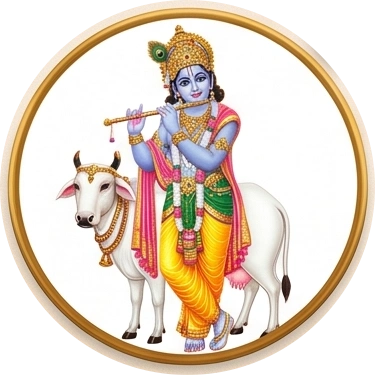
भगवान कृष्ण
पूर्ण अवतार की संपूर्ण अभिव्यक्ति — शिक्षा, कला और दिव्य कौशल
वैदिक परंपरा में मानव उपलब्धियों को ६४ कलाओं में वर्गीकृत किया गया है। कृष्ण पूर्ण अवतार हैं जिन्होंने इन सबका प्रकटीकरण किया।
श्रीमद्भागवत (१०.४५) के अनुसार कृष्ण और बलराम ने गुरु सांदीपनि के यहाँ मात्र ६४ दिनों में सभी कलाएँ सीखीं।
६४ कलाओं में ललित कला, संगीत, युद्धनीति, अभियांत्रिकी, कूटनीति, भाषा और आध्यात्मिक विद्याएँ समाहित हैं।
अष्ट-दिशा कला-मंडल
पहले किसी कला-समूह को चुनें, फिर उसकी आठ कलाओं में जाएँ। यह आधुनिक अध्ययन-विभाजन मूल क्रम को बदले बिना सूची को सरल बनाता है।
संगीत, नृत्य, नाट्य, चित्र, पुष्प-सज्जा और पवित्र दृश्य अभिव्यक्ति।
प्रसाधन, अंतःसज्जा, जल-कला, दृश्य भ्रम, माला और उत्सवी शिरोभूषण।
वेश, आभूषण, सुगंध, रूपांतरण, इंद्रजाल, हस्तलाघव और पाक-कौशल।
पेय, सूचीकर्म, कठपुतली, वाद्य, पहेली, पाठ-क्रीड़ा, गूढ़-पाठ और वाचन।
कथा, काव्य, बुनाई, कताई, काष्ठकला, वास्तु, रत्न और धातु-विज्ञान।
रत्न, वनस्पति, पशु-व्यवहार, उपचार, संकेत, कूट और भाषाओं का ज्ञान।
मंडप, यंत्र, स्मृति, सामूहिक पाठ, रचना, संपादन, रणनीति और छंद।
वेश-परिवर्तन, क्रीड़ा, आकर्षण, बाल-शिक्षा, शिष्टाचार, युद्ध, स्तुति और दिव्य कर्म।
संगीत, नृत्य, नाट्य, चित्र, पुष्प-सज्जा और पवित्र दृश्य अभिव्यक्ति।
The ability to sing in perfect resonance with raga, tala, and emotional nuance.
Krishna's divine singing along the banks of the Yamuna charmed the gopis, forest animals, and even caused the flowing river to pause in ecstasy.
Expertise in playing wind, string, and percussion instruments.
His mastery over the Bansuri (bamboo flute) produced melodies so profound that it bewitched the entire ecosystem of Vrindavan.
Conveying deep spiritual emotions through body movement and hand gestures (mudras).
During the Rasa Leela, Krishna danced simultaneously with hundreds of gopis, manifesting multiple forms to match each dancer's rhythm.
The skill of performing character portrayals with immersive emotional impact.
Krishna seamlessly adapted his persona—appearing as a playful child to Yashoda, a fearsome warrior to Kamsa, and supreme divinity to Arjuna.
Capturing expressions, forms, and colors on canvas or surfaces.
Krishna drew exquisite leaf and flower designs (Patravali) on the faces of his companions in Vrindavan.
Creating symmetrical cosmetic art using sandalwood, kasturi, and kumkum.
Krishna adorned himself and his friends with intricate forehead designs and forest pigments before leading the cows to pasture.
Arranging colored grains, rice, and fresh petals into geometric mandates.
Arranging elaborate floral altars along the banks of the Yamuna for sacred forest festivals.
Designing comfortable and aromatic seating or resting surfaces with petals.
Preparing scented bowers (Kunja) in the groves of Vrindavan using forest blossoms.
Applying fragrant natural pastes and dyes for health and aesthetics.
Accepting the scented paste offered by Trivakra (Kubja) in Mathura and enhancing her physical beauty in return.
Designing jeweled architecture and encrusting precious gems into metal.
Designing the crystal and gem-encrusted floors of the palace at Dwarka under Vishwakarma's guidance.
Constructing furniture optimized for rest, posture, and elegance.
Arranging comfortable rest areas in the royal assembly halls of Dwarka.
Generating melodic scales by striking water-filled bowls or splashing patterns.
Engaging in water sports (Jala-Kreda) in the Yamuna and producing rhythmic musical beats on the water's surface.
Directing water jets or swimming maneuvers during water battles.
Playfully outmaneuvering the cowherd boys during aquatic games in the river.
Manipulating light, reflection, and form to create artistic illusions.
Expanding his form into thousands during the Rasa Leela so every gopi felt he was standing uniquely beside her.
Stringing flowers with specific color harmonies, scents, and structural durability.
Crafting the iconic Vyjayanthi garland made of five types of forest wildflowers.
Designing royal or rustic headgear incorporating feathers, crests, and cloths.
Styling his crown with a peacock feather (Mayur Pankh) set at a perfect, iconic angle.
Selecting apparel that highlights personality, role, and cultural aesthetics.
Dressing in his signature Pitambara (yellow silk garments) that complemented his dark complexioned form.
Carving intricate ear accessories out of natural materials.
Wearing shark-shaped earrings (Makarakundala) that glinted against his cheeks.
Distilling plant extracts to create long-lasting aromatic compounds.
Blending aguru, musk, and sandalwood pastes for royal ceremonies in Dwarka.
Understanding metal, gem, and attire compatibility for maximum elegance.
Adorning himself with the Kaustubha gem and gem-studded armlets for formal royal assemblies.
Demonstrating feats that surpass ordinary perception.
Showing his mother Yashoda the entire cosmos spinning inside his open mouth after eating a lump of clay.
Altering voice, body language, and look to bypass detection.
Disguising himself as a Brahmin along with Bhima and Arjuna to enter Jarasandha's fortress undetected.
Executing physical tasks with lightning speed and precision.
Unsheathing, loading, and firing arrows with his bow Sharanga so rapidly that observers saw only a continuous stream of light.
Advanced cooking, baking, and culinary presentation.
Receiving and savoring the humble beaten rice (Poha) brought by Sudama with supreme pleasure and granting riches in return.
Blending spiced fruit extracts, coolers, and restorative beverages.
Mixing cooling herbal sherbets for weary travelers and sages visiting Dwarka.
Precision stitching, weaving, and pattern repair on silk and cotton.
Instantly extending Draupadi's saree through an endless stream of woven silk during the assembly hall crisis.
Controlling stringed wooden figures to tell stories.
Manipulating the forces of the universe as a divine puppeteer, guiding the outcome of the Kurukshetra war.
Mastering classical stringed instruments and sacred rhythmic drums.
Playing musical duets with Narada Muni during spiritual discourses.
Intellectual wordplay designed to test mental sharpness.
Engaging in subtle philosophical riddles with King Yudhishthira during political conferences.
Instantly reciting scriptures starting with the ending letter of the previous verse.
Engaging in intellectual verse contests with young princes at Sandipani Muni's ashram.
Reading and translating encrypted script or complex ancient dialects.
Instantly interpreting complex Vedic hymns and obscure geopolitical treatises for assembly scholars.
Chanting prose and verse with correct meter, intonation, and clarity.
Reciting philosophical discourses to assembly sages in a voice echoing like thunder.
Narrating engaging stories imbued with moral principles.
Narrating cosmic histories to Arjuna during times of rest between battles.
Improvising the final line of a verse to complete its meter and meaning.
Spontaneously finishing poetic praise composed by visiting royal bards.
Weaving light, durable shields and basketry for practical utility.
Constructing functional camp equipment during forest journeys.
Transforming raw cotton and wool into fine, uniform thread.
Demonstrating domestic self-reliance at the gurukula ashram.
Shaping raw timber into chariots, doors, and furniture.
Assisting in building wooden chariots and camp shelters during campaigns.
Designing cities according to structural, environmental, and geometric harmony.
Masterminding the impregnable sea-fortress city of Dwarka with wide avenues, moats, and fortified gates.
Identifying real versus synthetic gems and evaluating raw precious metal ore.
Evaluating the divine Syamantaka jewel and clearing his name through systematic investigation.
Extracting pure metals from ore and manufacturing durable alloys.
Overseeing the forging of high-grade armor and weapons for the Yadava army.
Treating raw stones using controlled heat and chemical solutions.
Selecting and polishing stones to decorate the royal scepter of Dwarka.
Cultivating flora, curing tree diseases, and maximizing crop yield.
Planting the celestial Parijata tree in Dwarka and restoring its bloom.
Understanding animal instincts for defense, farming, or transport.
Calming wild bulls, such as the seven fearsome oxen of King Nagnajit, to win Satya's hand in marriage.
Training parrots and mynahs to repeat mantras or messenger signals.
Training forest birds to carry discreet messages across Vrindavan.
Relieving physical fatigue using herbal oil massage and pressure points.
Massaging the tired feet of his elder brother Balarama and elders like Ugrasena.
Transmitting complex messages non-verbally across crowded halls or battlefields.
Using subtle hand signals to guide Bhima during his wrestling duel against Jarasandha.
Communicating fluently with non-Vedic cultures and interpreting codes.
Decoding Vidura's warning message delivered in a secret dialect regarding the wax palace (Lakshagraha).
Speaking effortlessly with people across various geographic territories.
Conversing with mountain dwellers, forest tribes, regional kings, and celestial beings in their native dialects.
Creating temporary structures using wood, cloth, and floral garlands.
Designing decorated floats for royal processions during the Rajasuya Yajna.
Constructing pulley systems, catapults, and self-operating gates.
Installing revolving defensive siege engines along the perimeter towers of Dwarka.
Retaining massive volumes of information after hearing it just once.
Memorizing all Vedas and treatises instantly upon a single reading at Guru Sandipani's ashram.
Synchronizing tone, pitch, and rhythm across large gatherings.
Leading the assembled cowherds in morning chants and forest prayers.
Instantly composing profound verse mentally without draft or delay.
Spontaneously delivering the poetic, rhythmically complex Bhagavad Gita on the battlefield of Kurukshetra.
Evaluating literary works for structural balance, metaphor, and syntax.
Correcting philosophical treatises presented by scholars in his royal court.
Creating tactical diversions to disorient adversaries without unneeded bloodshed.
Creating the illusion of an early sunset to lure Jayadratha out of hiding during the Kurukshetra war.
Understanding etymology, synonyms, and poetic structures.
Utilizing precise, multi-layered Sanskrit vocabulary with double meanings during diplomatic negotiations.
Quick-change disguises and tactical camouflage.
Hiding the clothes of the gopis during the Saka-Leela to teach a spiritual lesson on abandoning material illusion.
Mastering the mathematics of dice rolls and game mechanics.
Declaring in the Bhagavad Gita: 'I am the gambling of cheats' (Dyutam Chhalayatam Asmi), acknowledging his mastery over game theory.
Utilizing natural magnetism and charismatic aura to draw focus.
Attracting the minds of all sages, kings, and commoners merely by walking into an assembly.
Understanding child development and crafting interactive playthings.
Inventing creative games and playing with the village children of Gokula.
Knowing how to honor guests, kings, elders, and ascetics appropriately.
Washing the feet of Sage Narada and King Yudhishthira during public ceremonies to demonstrate humility.
Designing battlefield formations (vyuhas), logistics, and strategic retreats.
Executing a strategic retreat (earning the title 'Ranchhod') to lure Jarasandha away from Mathura, saving thousands of civilian lives.
Composing morning hymns that awaken kings and deities with positive resonance.
Awakening the elders and court guests in Dwarka with sacred chanting at dawn.
Exercising absolute power over physical laws, gravity, and nature.
Lifting the massive Govardhan Hill on his pinky finger for seven days to protect the inhabitants of Vrindavan from torrents of rain.
कृष्ण की ६४ कलाएँ याद दिलाती हैं कि दिव्य जीवन कला, कर्म और भक्ति का पूर्ण संगम है।
पूर्णता एक कला में नहीं; धर्मयुक्त जीवन की समग्रता में है।
← भगवान कृष्ण गाइड सभी देव-देवी